For any suggestions or feedback regarding these notes,
please contact Pragy Agarwal
Approaching a Design problem
DSA Interviews
- Problem statement is concrete - well defined
- Example input-output pairs
- Idea about the kind of solution that will work
- input constraints
- input: array of integers of size 10^6
- can you use a O(n^2) algo? No. Max O(n log n)
- Problem Statement
- Examples - solve it by hand
- Brute Force
- Draw observations
- Optimized
Design Interviews
- Problem statement is extremely vague
"Design Typeahead" - you might not even know what typeahead is
- interviews are very open ended
- discussion can go in any direction
- depends on your expertise
- depends on the interviewer's expertise
- interviews are still time constrained
- 45 mins
- you must
- what you're supposed to build
- figure out what the interviewer wants
- build that solution
- take sufficient complex things so that you can showcase your skills & impress the interviewer
The 5-step design approach
(20-25 mins)
- Problem Statement
- Functional Requirements
- Non-functional Requirements
- Scale Estimation
(25-20 mins)
- API Design
- System Design
Problem Statement
Reason by analogy
Find existing companies / systems that offer a similar product / feature.
Gives you an overview of the umbrella of different scopes that you can consider.
Typeahead is a specific form of autocomplete.
Try to type-ahead of the user
Typeahead in Google
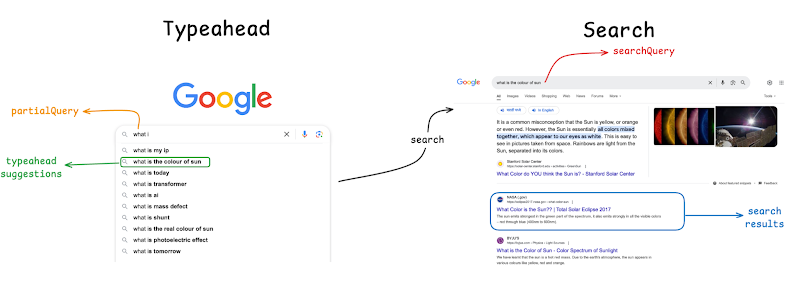
Typeahead in Amazon
.png)
Typeahead & Search are different products
but typeahead is always followed by with some form of search.
.png)
What not to build
Autocomplete is available in many different settings
- Smartphone Keyboards: word completion / contacts / ..
- Text editors / Code editors:
- intellisense: complete next token
- Github CoPilot: can show entire functions
- Grammarly: sentence completion while prose writing
- Gmail / Outlook:
- sentence completion for writing mail
- to/cc/bcc: email completion from contacts
Key difference b/w Typeahead & Autocomplete
Autocomplete is typically local to your machine. Any suggestions are specific to you. Autocomplete is standalone.
Typeahead is always associated with search.
The list of suggestions in typeahead are the most popular queries searched globally in the past, that match the given prefix.
Functional Requirements (FR)
Minimal Viable Product (MVP)
- Minimal: minimal set of features to achieve viability
- Viable: should demonstrate the core features & usability
- Product: solve a genuine problem
.png)
Actors
- End User: the person doing the google search
MVP Features
Always keep the "minimal" in your mind. MVP features is not a feature suggestion competition.
MVP features perfect for discussion | Future Scope | Bad |
As the user is typing in the search-box, we should auto-complete their search query. typeahead(partial_query) => suggestions_list user-facing | Typeahead results should be personalized
| Display a textbox in which the user can type something (frontend) |
The suggestions shown in typeahead are popular searches that other people have made in the past log_search(search_query) => void internal | Results should take recency/news factor into consideration | Clicking a typeahead suggestion should lead to a search (frontend) |
We will limit to showing only top 5, relevant suggestions.
| Fix typos/Spell-correct the user's partialQuery before showing the typeahead results | While showing the suggestions, the part that has already been typed should be highlighted (frontend) |
With every letter that the user types, the typeahead suggestions should change | Even when the user has typed < 3 characters, we should suggest the "trending" global searches / previous recent searches by the user | after giving suggestions, if user press tab button, it should write copy the query in the text box (frontend) |
We will start showing typeahead suggestions only
| user age based personalization | |
Grammar-correct the user's partialQuery before showing the typeahead results | ||
provide suggestions as per the law of the land |
What to avoid
- anything that doesn't effect our backend infra / system design
- frontend features
- don't effect our backend infra / system design
- purely cosmetic
- common features that are not the core of the system that we're trying to build
- design Uber
- we require authentication
- is authentication what the interviewer is asking you to design
no - it's just a dependency - we require payments
- when the interviewer asks us to design Uber, they're not asking us to design payments
- we will assume that auth & payments already exist
- any suggested feature should come in the form of a complete sentence (from the user's perspective)
Hidden features
How to find hidden features?
For every feature that you discuss, think of the following
API (internal / user-facing)
typeahead(partial_query) => suggestions_list
user-facing
log_search(search_query) => void
internal
GET /typeahead?partialQuery={}
- why REST why not SOAP / RPC / ...
- why GET, why not POST
- naming convention
API: input & output (interface)
Protocol: how the communication happens (REST / ...)
Data Source & Flow
Where does the list of suggestions come from?
.png)
Users are constantly searching on Google.
Every time a user makes a search (search_query)
- this search_query goes to the /search microservice
- search microservice will return the relevant web-results
- (async) the search microservice will inform the /typeahead microservice that this search has been made (pass the search_query)
- the /typeahead service can store this search_query to populate its suggestions list
Non-Functional Requirements (NFR)
(design goals)
PACELC
Consistency vs Availability
Do NOT jump to an answer
Q: What is the data ?
Past search queries and their corresponding counts.
Search Query | Count |
why is the sky blue? | 49,999 |
why is water wet? | 50,000 |
what is the color of the ocean | 5,000 |
Q: What does eventual consistency mean in this context ?
When is the data changing?
Everytime someone makes a search, the count of some entry changes.
Everytime someone makes a search, the top-5 relevant results for some typeahead partial_query changes.
It is possible for the search-count to reflect in a delayed manner in the top-5 results.
For some time, it is possible that the true count of Query1 > Query2, but we still show Query2 before Query1 in the typeahead suggestions.
Q: Can we afford stale reads in this situation?
Yes, that's okay
- because the user doesn't really know (or care about) the true search counts
- we don't necessarily need to maintain a strict order in the typeahead suggestions
- it is okay for a few good suggestions to not be shown, as long as the ones shown as also good enough
Q: What does data loss mean in this context ?
Data loss would happen if someone has searched for a query, but for whatever reason, we were not able to increment the count for that query (query didn't get logged).
The counts will be off by a small amount.
Search Query | True Count |
why is suryakumar dropped? | 49,999 |
why is water wet? | 50,000 |
what is the color of the ocean | 5,000 |
Search Query | DB Count |
why is suryakumar dropped? | 49,999 |
why is water wet? | 49,998 |
what is the color of the ocean | 5,000 |
Q: Can we afford data loss in this situation?
Yes, that's okay.
(same reasons as above)
Consistency vs Latency
What are our latency requirements?
Ultra-low latency - literally competing with the user's typing speed!
each typeahead query to take < 10ms
(this doesn't include the round trip - that depends on the user's distance from the servers - don't have much control over that - only solution for that is to have geolocated servers)
Others
- Security: do NOT do this unless you're a security expert
- 99% of all security issues happen because non-security expert devs try to do security
- Observability
- Rate Limits
- Idempotency
- Delivery Guarantees
Scale Estimation
The scale will dictate our design choices
Goals
- Amount of Data
- Is sharding needed?
- Amount of Load
- Requests per second (for each API)
- Peak Load (vs avg load)
- Read-heavy / Write-heavy
All these things will help us guide our choice of database, cache, & sharding
Does accuracy matter?
No. Back-of-the-envelope estimates.
being off by a factor of 2 or 3 is okay.
Actual value: 100
You suggest: 50 okay
You suggest: 200 okay
You suggest: 10 not okay (off by a factor of 10)
However, any estimates that you make should be justified. Don't pull out numbers from thin air. You will have to make some assumptions - each assumption should be clearly stated as such.
How to start
Start by estimating the number of daily active users.
World Population: ~8 billion
Number of Internet Users: ~5 billion
India's Population: ~1.4 billion
USA's Population: ~350 million
Pareto Principle (the 80/20 rule)
Only 20% of your users will be active.
Can be extended to the 80-20-1 principle for social media
- 80% are just passively browsing
- 20% are interacting (comments, likes, shares)
- 1% are content creators (posts)
.png)
.png)
Estimates
assumption: Google has 5 billion users.
Daily Active Users (DAU): 20%
= 20% of 5 billion users
= 1 billion users
assumption: Number of searches per active-user per day: 20
Total number of searches / day
= (20 searches / user / day) * (1 billion users)
= 20 searches / day * 1 billion
= 20 billion searches / day
Avg. searches / second
= 20 billion searches / day
= 20 * 10^9 searches / (10^5 seconds) (1 day = 86400 seconds ~ 10^5 seconds)
= 200,000 searches / second
Note: searches are going to search API, not the typeahead API
assumption: Number of typeahead queries per search query: 10
avg size of a search query is 10 letters
we will start showing suggestions after the first 3 letters
number of typeaheads per search would be (10 - 3) = 7 ~ 10
typeahead(...) API: requests / second
Everytime a user is searching for something, they will first type the query, and then they will search.
search_query: "why is the sky blue"
- typeahead("why")
- typeahead("why i")
- typeahead("why is")
- typeahead("why is t")
- typeahead("why is th")
- typeahead("why is the")
- typeahead("why is the s")
- ...
- typeahead("why is the sky blue")
= (200,000 searches / second) * (10 typeaheads / search)
= 2 million typeaheads / second
log_search(...) API: requests / second
Every time a search is made, the /search microservice pings the /typeahead microservice
= 200,000 requests / second
Peak Load
= 5x the average load
= 5 * (2 million typeaheads / second)
= 10 million typeaheads / second
.png)
.png)
Amount of Data
What's the data?
Past search queries & their counts
Search Query | True Count |
why is suryakumar dropped? | 49,999 |
why is water wet? | 50,000 |
what is the color of the ocean | 5,000 |
Avg. size of search query: 10 letters (made this assumption earlier)
How many entries in this table?
Should we say that for each search that happens, we will have an entry in this table?
No. Because for new searches, we're adding entries
But for queries that have already been searched earlier, we're just updating the counts
The number of entries in the table will depend on the number of "unique" (never seen before in the history of Google) search queries that happen
assumption: % of search queries are new (never seen before) = 0.1%
assumption: % of search queries are new (never seen before) = 10%
number of new entries / day
= 10 % of (20 billion searches / day)
= 2 billion entries per day
amount of data / day
= (10 bytes / entry) * (2 billion entries / day)
= 20 GB / day
total amount of data (over 20 years)
= (20 GB / day) * (20 years)
= (20 GB / day) * (20 * 400 days) (365 ~= 400)
= 16 * 10^4 GB
= 160 TB
Can this amount of data fit on a single server?
Probably yes, with modern storage.
But, will a single server be able to handle 10 million requests / second?
Absolutely no!
We need sharding!
Read Heavy / Write Heavy?
typeahead => read query => 2 million requests / second
log_search => write query => 200,000 requests / second
reads are 10x more than writes
We will call this read heavy, because even though the system has to handle lots of writes too, it is dominated by reads.
Whenever you've read heavy systems & the writes are also significant
- you can absorb your reads in a cache
- optimize your DB for writes
No database system is optimized for both reads & writes (that's impossible)